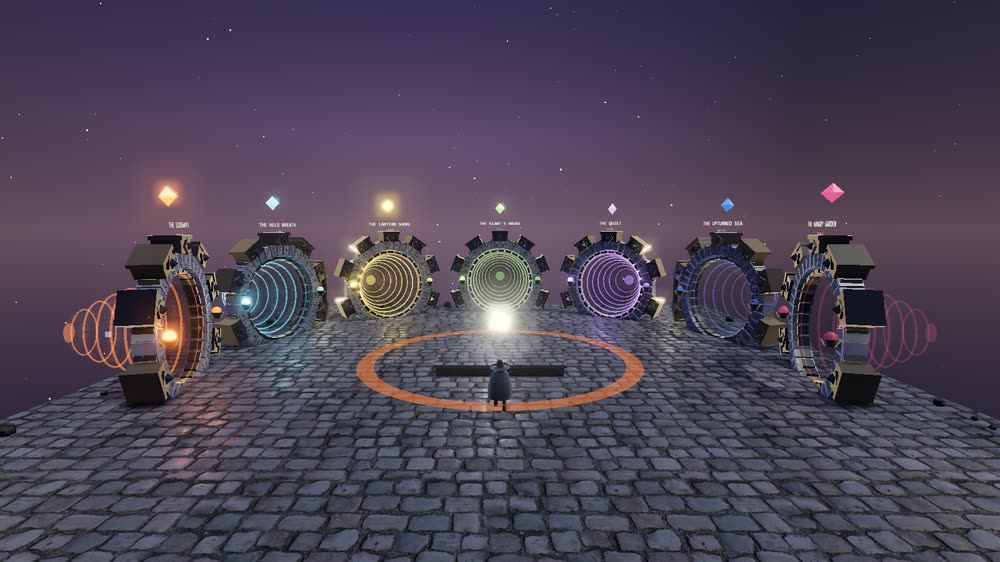
The Waystation in Misrule: seven ringed gates standing in an arc on a cobbled platform under a violet starfield, five of them lit and turning, two dark and locked, with a lone cloaked surveyor in a glowing orange ring at the centre.

Eventigames · Licences

The store, and what you would actually be buying

A licence here is a key bound to your machine, issued once and checked on your own computer. It is not an account you can be locked out of, and it is not a service that has to be up for you to play.

  • 0Games on sale today, counted in the file the checkout charges against
  • 0Prices decided. A price nobody set cannot be taken, and the shop refuses to try
  • 3Machines one key works on, so a new computer is not a second purchase
  • 14Days to change your mind, as long as the key has not been used

Nothing is on sale, so nothing here is switched on. The stones in this ring describe what has been built and what it will do, so that when it does open nobody is surprised by any of it.

The WaystationSeven gates, one for each broken law. Five of them are open.

Four steps · One of four

From payment to playing, step by step

The entire process, so there are no surprises in it.

What happens

1 — You pay
Card or PayPal, on this site. One payment; no subscription and no account to create first.
2 — A key is made for you
Your key is worked out from the game you bought and a secret only we hold. It is not picked off a list, so there is no list to steal and nobody can guess their way to a working one.
3 — It arrives by email
Within a few seconds. If it does not, the same key can be re-sent to the address that paid, as many times as you need.
4 — You activate once
Paste the key into the game the first time you run it. It binds to that machine and the game stops asking. After that it plays offline.

One payment · Two of four

What a licence actually buys

The terms in plain words, before there is anything to sell.

Terms

One licence, your machines
A licence is yours, not a single computer’s. It activates on the machine you play on, and it can be moved when that machine is replaced or rebuilt. You are not buying a seat you can lose to a motherboard.
The key is bound, not phoned home
Activation binds a key to a machine fingerprint once. After that the game checks the key it already holds. It does not need to reach us to let you play, and an outage on our side is not an outage on yours.
Updates for the version you bought
Misrule is being built in the open. A licence covers every build of the version line you bought into, including the realms that are not written yet.
Co-op does not need four licences
A session is hosted by one licensed player. Guests joining that session do not each need a key. Buying the game for a group means buying it once for whoever runs the room.

What a licence is not: it is not a rental, it is not tied to a store account, and it does not stop working on the day we switch something off.

Bound, not phoned home · Three of four

What a key is bound to, and how to move it

A key is a signed statement that you own the game. Activation ties it to one machine so that one purchase is one player, and that is the only thing the binding is for.

The fingerprint is derived from stable properties of the computer, not from anything personal. It does not identify you, it is not sent anywhere after activation, and it cannot be used to track what else the machine does.

What this means in practice

  • You can play with no internet connection at all once activated
  • A rebuild, a new drive or a new PC needs the seat released — ask, and it is released
  • We can see that a key was activated and roughly when; we cannot see what you play or when you play it
  • The secret your key is made from is held in one place we control, and it is never in the game you download nor in the published source of this website

Straight answers · Four of four

The questions people actually ask

Can I buy Misrule today?
No. The checkout is built and it is switched off, because no price has been decided and the game is not finished. When both of those change, this page changes with them.
Why build a shop with nothing in it?
Because the alternative is building one in a hurry on the day there is something to sell. Taking money is the part of a website where being half-finished costs somebody other than us.
Will there be a demo or a trial?
Yes. The trial is a first-run clock checked against network time rather than your own, so putting the date back does not extend it. The studio’s other software already works this way.
What happens if I change my PC?
You release the old machine, or ask us to release it, and activate the new one. Nobody should have to buy a game twice because a drive failed.
Is any of this in the game yet?
Not yet. The half that sells a key is written; the half that lives inside Misrule and checks one is not. Every build being tested today runs unlicensed.

This page, checked against the shop

This page can be wrong, so it asks

Everything above was printed when this page was built. The shop is a separate thing that keeps running afterwards, and the two can drift apart between one and the next.

That is not a hypothetical worry. The price of Misrule was held in two places on this site, and for a while they said different things — one said £19.99 and the other said no price had been decided. Both were being served, in public, on the same afternoon.

There is now one place, and it is the one the money is taken against. The numbers below were read out of it while this page was made. Press the button and the page asks the shop directly whether they are still true.

What the shop said when this page was made

Those three figures were true on 2026-09-05, which is the day this page was made and not today. The shop keeps running after the page is printed, so the only honest thing a printed page can say is when it was printed.

The button asks the shop itself, live, and prints whatever it answers — including a disagreement with the numbers above.

Fourteen days · more than the minimum

Getting your money back, and the bit we could have hidden

The law lets a shop selling downloads make every sale final the instant the file starts arriving. Almost all of them do. This one does not, and the reason is worth being honest about.

It is not generosity. A key that has never been activated has cost us nothing and given you nothing, and the ledger already records which is which — so the fair line and the easy line happen to be the same line.

The terms

Fourteen days, if the key is unused
Ask within fourteen days and you get the money back, as long as the key has not been activated. We can see whether it has. We cannot see anything else.
Activated means you have had it
Once a key is activated the game is yours and the refund window closes. That is the trade: no trial period to police, and no questions asked before then.
A broken game is always refundable
If what you bought does not work as described, the fourteen days do not apply and neither does activation. You are owed a fix or your money, and that is the law rather than our policy.
Refunds come back the way they went out
To the same card or account that paid. We do not issue credit, vouchers or a balance to spend here.

To ask for one, write to the address on the front page from the account that paid, with the order number. There is no form and no queue, because there is not yet enough of a shop to need either.

The United Kingdom, for now

The dull answer that decides who can buy

Selling a downloadable game to somebody in another country is taxed where they live, and in several places that starts at the first sale rather than after a threshold. It is the least glamorous fact about running a shop and it decides the most.

Where that leaves us

What the price includes
The price you see is the price you pay. There is nothing added at the end, and no fee for using one way of paying over another.
Where we can sell
The United Kingdom, for now. Selling a downloadable game to somebody abroad means paying tax where they live, in some places from the very first sale, and we are not registered to do that yet.
Why that is not a marketing decision
It would be easy to take the money and worry later. Plenty do. The bill still arrives, and it arrives with interest, so the checkout asks where you are and says no politely rather than finding out afterwards.

This will change. Registering to collect tax across Europe is paperwork rather than a wall, and a game people abroad want to buy is a good reason to do the paperwork. Until it is done, the checkout says no rather than finding out later.

The question nobody asks out loud

What you keep if this studio stops existing

Small studios close. The polite thing is to not mention it on the page where somebody is deciding whether to pay, which is exactly why it belongs here.

What survives us

  • Your key keeps working. It is checked by the game on your own machine, and there is nothing of ours it has to reach
  • The last build you downloaded stays yours, and it does not stop at a date
  • You never needed an account, so there is no account to lose
  • Nothing you bought was a subscription, so nothing quietly stops

None of that is a promise we would have to keep by being alive. It is a description of how the key already works: it is checked by arithmetic on your own machine, and there is nothing of ours for it to fail to reach.

A note from whoever is typing

I did not decide what this shop is

I wrote this page. I did not decide what this shop is, and on a page about money that difference is worth stating plainly.

There were three shops it could have been. One that only points you at where the games already are. One that hands you to somebody else’s checkout and lets them hold the money. Or this one, which takes it here and issues the key itself. I set the three out; the person who owns the studio chose the third.

Four things on this page are still open, and every one of them is theirs to settle rather than mine. The price of Misrule. Whether we sell outside the United Kingdom. The wording of the refund. Whether the shop is yet joined up to anything that could take a payment.

The page says all four are undecided instead of filling them in, and that is the whole point of it. A number I invent on a shop page is not a rough estimate. It is a price, and somebody will read it as a promise.

That has already happened here once. There is a section further up about a price nobody ever agreed, sitting in one file while the page above it said no price had been set. It was typed early because it looked plausible, and plausible is the exact way I go wrong.